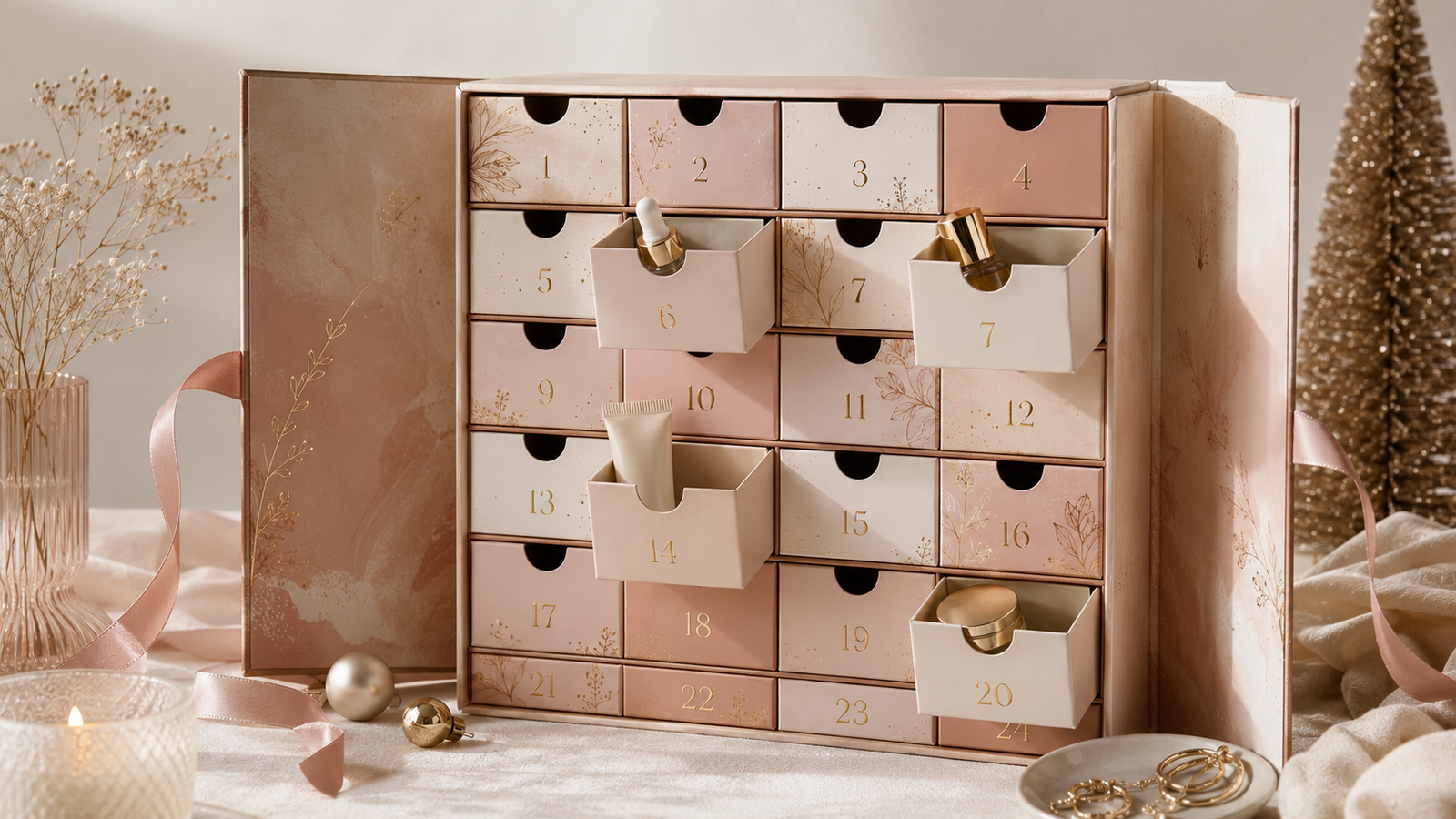
What beauty advent calendars actually are
A beauty advent calendar is a box containing 12, 24, or sometimes 25 numbered compartments, each holding a different beauty product. Traditionally aligned with the Advent season leading to Christmas, the format has spread beyond its religious origin to become a global beauty shopping moment.
The contents typically span multiple product categories:
- Skincare (cleansers, serums, moisturizers, masks)
- Makeup (lipsticks, mascaras, blushes, eyeshadows)
- Fragrance (perfume samples, scented candles, body sprays)
- Hair care (shampoos, conditioners, treatments)
- Body care (body lotions, scrubs, bath products)
- Tools and accessories (brushes, sponges, headbands)
The product sizes vary widely — some calendars feature mostly full-size products, others mostly samples. A "deluxe sample" (around 5-15ml) is the most common size; full-size products feature in premium calendars and as occasional highlights in mid-tier ones. Some calendars label contents to indicate full-size versus sample, which is helpful; many don't, which makes comparing value harder.
Why the market has exploded
The beauty advent calendar category has grown roughly tenfold since 2015. Several factors converged:
The "drop" psychology
Limited-quantity, time-limited releases create scarcity-driven demand. Beauty brands learned from sneaker culture how powerful drop psychology is, and the advent calendar format is essentially the perfect drop — limited quantity, single release window, FOMO-driven.
The Instagram and TikTok unboxing effect
Beauty advent calendars are highly photogenic and naturally serial — opening one a day for 24+ days produces 24+ pieces of social content. The visual appeal made them dominate beauty content during November and December, which amplified demand.
The gift economy
Calendars present as gifts (especially to oneself), which makes the spending feel more justifiable. "A small treat each day" reframes a single-purchase $300 decision as 24 small daily experiences.
The brand discovery angle
For brands, calendars are highly effective marketing. Getting a sample of an expensive product into a customer's hands often produces follow-up full-size purchases. Brands willingly accept low margins on calendar products because of this conversion effect.
The price-anchor inflation
Premium calendar pricing has crept upward year over year. What were $150 calendars in 2018 are now $250-$350. The "value" claims have inflated proportionally, but the relationship between stated value and real perceived value has weakened.
The honest value math
The "value" claim is the central marketing point of every beauty advent calendar — typically presented as "$500 worth of products for $185" or similar. This claim needs careful unpacking.
What the stated value usually is
Most advent calendars cite the sum of full-size retail prices for the products inside. This is technically accurate but often misleading:
- Sample-sized products are valued at their proportional share of full-size MSRP. A 10ml sample of a 50ml $80 serum is valued at $16, even though no retail equivalent exists at that size
- Full-size MSRP is often higher than what items actually sell for; sale prices and bundle discounts mean retail value claims overstate what you'd actually pay
- Some products in calendars are slow-moving inventory the brand wants to clear; the "value" reflects desperation pricing for items that wouldn't sell at full price
The realistic value calculation
Three honest adjustments to apply to any stated value claim:
- Discount the stated value by 30-40% to reflect actual market prices versus MSRP
- Apply a "use rate" of 50-70% — most buyers genuinely use only this percentage of calendar contents
- Subtract products you wouldn't have bought anyway — sample bottles that sit unused don't count as "value"
The math example: a calendar with "$500 stated value" sold at $200 might actually deliver $300 of real retail value (after MSRP adjustment), of which you'll use $180 worth (60% use rate), of which $120 worth would have been products you'd have purchased anyway. The honest "value" relative to your actual buying patterns is closer to $120 — still positive vs the $200 purchase, but far less than the $500 marketing claim.
This math isn't an argument against buying calendars — it's an argument for buying them with realistic expectations. A calendar that delivers $120-180 of value you'll actually use, at $200, is a fine purchase if you enjoy the experience and the discovery. It's not the dramatic "savings" the marketing suggests, but it's still a reasonable consumer transaction.
The strongest-value patterns
Calendars typically deliver the best honest value when:
- You already use multiple products from the featured brand
- The calendar focuses on a single brand or curated retailer (less likely to include random products)
- You'd have made purchases at this brand during the holiday season anyway
- The size mix favors full-size and deluxe-sample over tiny samples
- The brand has transparent product lists before launch (you can assess before buying)
The luxury tier ($300+)
The premium beauty advent calendar segment includes calendars from heritage luxury brands and high-end retailers. These typically launch earliest (August to early September), sell out fastest, and command the highest "value" ratios — at least in stated marketing claims.
Charlotte Tilbury Beauty Universe
Among the most consistently coveted premium calendars. Typically priced around £200-240 with stated value claims of £450-500. Contents include a mix of Charlotte Tilbury's bestselling skincare, makeup, and tools, mostly in deluxe-sample to full-size formats. Launches in early September and sells out within hours through the brand's website. Returns in waves through Sephora, Nordstrom, and other retailers.
Strongest for: Charlotte Tilbury fans who'd buy multiple full-size products from the brand anyway. The hit rate is high — most items are usable for most buyers.
Liberty Beauty Drop / Liberty Beauty Advent Calendar
London-based Liberty's calendar curates from across luxury brands they sell. Typically priced around £230-275 with stated value claims of £700+. Mixed brand content from Diptyque, Augustinus Bader, Le Labo, Aesop, Drunk Elephant, and similar premium brands.
Strongest for: People who want exposure to multiple luxury brands rather than depth in one. Multi-brand curation makes the hit rate variable but the discovery value high.
Jo Malone Advent Calendar
Among the most iconic premium calendars. Typically priced £400-450 with proportional Jo Malone product contents — colognes, candles, body products. Launches mid-September; sells out fast.
Strongest for: Established Jo Malone customers; weakest for people unfamiliar with the brand who might find half the scents don't suit them.
Diptyque Advent Calendar
The most prestigious fragrance-focused calendar. Typically £400-550 with candles, fragrances, and home products. Heritage French brand with strong international following.
Strongest for: Diptyque enthusiasts; very poor value for fragrance-skeptical buyers.
Le Labo Advent Calendar
Among the most exclusive — typically £600-750+, with limited release quantity. Contents focus on Le Labo's distinctive niche fragrance line.
Strongest for: Niche fragrance collectors with confirmed preferences for the Le Labo profile.
La Mer Advent Calendar
Skincare-focused premium calendar. Typically £550-650+ with sample-to-full-size La Mer products. The brand itself is premium-priced, so the calendar's value claim reflects that baseline.
Strongest for: Existing La Mer customers. Skeptics may find the underlying products don't justify their prices regardless of calendar packaging.
NET-A-PORTER and Mr Porter Beauty Calendars
The luxury retailer's curated calendars typically deliver multi-brand premium selections. Available to international buyers including India through their global shipping. Higher price point ($600+) with proportionally premium contents.
Selfridges Beauty Calendar
UK department store's annual calendar — typically £200-350 with strong multi-brand curation. Available globally through the Selfridges website.
The mid-tier ($100–$300)
The mid-tier segment offers stronger entry-level value with less sellout pressure. These calendars are widely available, launch in September-October, and typically remain in stock until at least early November.
Lookfantastic Beauty Advent Calendar
One of the most consistently well-reviewed mid-tier calendars. Typically priced £90-100 with stated value claims of £450-500. Contains 25 deluxe-sample to full-size products from skincare-leaning brands. Available globally including India through their international site.
Strongest for: Skincare-focused buyers wanting broad brand exposure at accessible price point.
Glossybox Advent Calendar
Around £75-95 typically, with 24 deluxe products from European beauty brands. Sample-heavy with occasional full-size highlights.
Strongest for: European beauty brand discovery; people who already use Glossybox subscription will find this familiar territory.
Boots No7 Advent Calendar
UK drugstore brand's premium calendar, typically £60-85 with No7 skincare and makeup products. Strong value within the No7 product universe.
Strongest for: Existing No7 fans; new buyers can fairly evaluate the brand's range through this single purchase.
Cult Beauty Beauty Advent Calendar
UK retailer's curated calendar, typically £180-225 with strong multi-brand premium selection. Often considered top mid-tier value when paired with Cult Beauty's broader sale events.
Trinny London Advent Calendar
Around £150-180 with Trinny's signature multi-use makeup products. Strong for makeup-focused buyers who want pigment and color experimentation.
Drunk Elephant 12 Days of Bondi Sands / Brand-Specific Skincare Calendars
Many premium skincare brands now release brand-focused calendars in this tier. Drunk Elephant, Sunday Riley, and others have done this. Brand-focused calendars typically deliver better hit rates for fans of that brand and worse for newcomers.
Body Shop Advent Calendar
Around £75-100 with Body Shop products. Cruelty-free, vegan-friendly contents. Strong for ethical-shopping priorities.
Sephora Favorites Holiday Box
Sephora's annual multi-brand box (not strictly an advent calendar format but similar concept) — typically $50-100 with curated samples and deluxe sizes from brands across Sephora's range. Widely available, easy to evaluate.
The affordable tier (under $100)
Under £100, beauty advent calendars work best as gifts, experiences, or entry-level discovery rather than value-driven beauty purchases.
Drugstore and supermarket calendars
UK supermarkets (Marks & Spencer, ASDA, Tesco) and US drugstores release affordable calendars annually for £20-50. Content is more functional than luxurious — basic bath products, drugstore makeup, small skincare samples. Functional gift options; not destination beauty purchases.
Soap & Glory, e.l.f., and similar accessible brand calendars
Mass-market brands release calendars at £25-50 price points with their own products. Best as introductions to the brand for newer customers or as gifts.
Pixi Beauty Advent Calendar
Around $50-80 typically with the brand's well-formulated products. Strong value within the segment.
Magazine subscription-included calendars
Several beauty magazines and subscription services (Birchbox, Allure) have released advent-format products at $30-60 price points. Mixed quality.
Walmart, Target, Ulta affordable options
US mass retailers release calendars at $30-70 price points. Mixed-brand content typically of variable quality.
The affordable tier is often the best option for first-time advent calendar buyers. The price point ($30-80) means even a mediocre experience represents low downside risk. If you discover you love the format, you can graduate to premium calendars in future years. If you discover the format isn't for you, you've learned that without spending $200-400.
The early-access and sellout game
Premium beauty advent calendars have evolved a specific dynamic worth understanding before buying:
The drop pattern
Most premium calendars follow a predictable release pattern:
- Early August to early September: Premium calendars announced with product reveals
- Email-list early access: Brands send 24-48 hour early-access codes to email subscribers
- Public launch: Open sale, often selling out within hours
- Sephora/retailer wave: Some inventory reserved for Sephora, Nordstrom, etc. — released as separate launches
- Restock waves: Limited restocks through October, often quickly sold
- Final availability: Late October to early November, scattered availability across retailers
Strategies for getting the calendars you want
- Subscribe to brand emails by July for August launches
- Follow brand social media for launch announcements
- Set calendar reminders for launch dates — premium calendars sell out within hours, sometimes minutes
- Check multiple retailers — different retailers carry different stock, and one site's "sold out" may not match another's availability
- Watch for restocks — many calendars restock 2-3 times before the season
- Avoid resellers — secondary market beauty advent calendars often command 2-3x markup with no verification of contents
The "FOMO trap"
The artificial scarcity creates strong urgency. Recognize this as engineered psychology, not actual rarity. Most calendars restock multiple times. If you miss an initial release, you usually have other opportunities. Don't make impulse decisions under sellout pressure for $300+ purchases.
Sustainability concerns
Beauty advent calendars have a documented sustainability problem worth being honest about.
The packaging issue
The calendar format requires substantially more packaging per unit of product than buying products individually:
- Outer decorative box (often cardboard with plastic windows)
- Inner segmented compartments (cardboard, plastic, or foam)
- Individual product packaging (smaller versions of full-size packaging)
- Decorative wrappers, tissue paper, ribbon
- Shipping materials for delicate items
The ratio of packaging to actual product is much higher than equivalent retail purchases — sometimes 3-5x more packaging per gram of product.
The waste cycle
Most calendar packaging is single-use. The decorative box, despite being beautiful, typically can't be reused for future calendars. Plastic windows and decorative elements often aren't recyclable.
Brands making efforts
Some brands have started addressing the sustainability issue:
- Recyclable cardboard structures replacing plastic windows
- Refillable or compostable calendar formats
- Larger product sizes that genuinely reduce per-unit packaging
- Recycled material content disclosure
- Take-back programs for outer packaging
The Body Shop, Aesop, and a few other brands have made notable improvements. The industry overall lags.
If sustainability matters to you
Consider: choosing calendars from brands with explicit sustainability commitments, prioritizing calendars with mostly full-size products (better packaging-to-product ratio), reusing calendar outer boxes for storage or future gift-wrapping, recycling all recyclable components carefully, and recognizing that buying products at retail in the products' standard packaging is more sustainable than buying calendars.
Beauty advent calendars in India
The Indian beauty advent calendar market is smaller than UK or US but growing. Current 2026 landscape:
Nykaa
India's largest beauty retailer increasingly stocks international advent calendars. Charlotte Tilbury, Bobbi Brown, and other major brand calendars have appeared through Nykaa Luxe in recent years. Pricing reflects import costs; availability is limited and sells out quickly.
Forest Essentials
India's luxury Ayurvedic brand has offered holiday gift sets that function similarly to advent calendars — curated multi-product collections in elaborate packaging. Strong domestic alternative to international options.
Kama Ayurveda
Premium Ayurvedic brand with occasional holiday gift sets featuring multiple products. Functional similarity to advent calendar format.
Sugar Cosmetics and Plum Goodness
Affordable Indian beauty brands offer multi-product gift sets at lower price points than imported advent calendars. Good entry-level options.
International calendars shipping to India
Lookfantastic, Cult Beauty, and other UK retailers ship to India but customs and shipping can add 30-50% to base prices. Delivery times during the holiday season can be extended. For Indian buyers wanting international advent calendars, consider:
- Ordering early (September for delivery before December 1)
- Calculating total landed cost including customs before purchasing
- Verifying retailer's India shipping policies
- Using forwarding services for retailers that don't ship directly to India
Who beauty advent calendars actually work for
Beauty advent calendars work for:
- Existing beauty enthusiasts who would buy multiple products from featured brands anyway
- Gift recipients — calendars make distinctive holiday gifts
- Brand discovery seekers who want to explore a curated selection
- People who love unboxing rituals — opening doors throughout December is the actual product being purchased
- Established makeup collectors for color and shade experimentation
- Holiday traditions — for households where this has become an annual ritual
Beauty advent calendars don't work for:
- Strict value optimizers — the math rarely beats targeted purchases at sale prices
- Minimalists — the format inherently generates clutter and partial products
- Sensitive skin sufferers — unknown formulations across 24 products is high allergic reaction risk
- Sustainability-focused buyers — the packaging waste is significant
- People with settled, minimal routines — calendars actively disrupt simple effective routines
- Anyone susceptible to FOMO purchasing — the sellout urgency is engineered to bypass deliberation
The honest pre-purchase test
Before buying any beauty advent calendar, ask yourself:
- Would I buy at least 60% of these products at full price? If yes, the calendar is likely good value.
- What will I do with the products I don't use? If you have a clear answer (donate, regift, etc.), proceed. If not, recognize the actual cost is higher than the price tag.
- Am I buying for the experience or for the products? If the experience (opening doors, daily ritual), then the value math doesn't have to work. If for the products, the math should be honest.
- Have I checked the product list before buying? Premium calendars often reveal contents in advance — use this information.
- Could I get equivalent value buying products individually during Black Friday or similar sales? Often yes, with less packaging waste.
The bottom line: Beauty advent calendars are a legitimate category that works wonderfully for some buyers and poorly for others. The major premium options (Charlotte Tilbury, Liberty, Diptyque, Jo Malone) deliver excellent experiences if you'd use most of the contents and would have made similar purchases at retail. The mid-tier (Lookfantastic, Glossybox, No7) offers strong entry-level value with less FOMO pressure. Affordable calendars work best as gifts or first-time experiments. The category has a real sustainability cost and the "huge savings" math is usually 2-3x oversold. Buy calendars for the experience and discovery they offer; treat the value claims with the same skepticism you'd apply to any other beauty marketing. Set calendar reminders for premium launch dates if you want specific ones; avoid impulse buying under sellout pressure for purchases this size. The calendars that bring you joy are worth their price. The calendars that bring you guilt aren't.